

In the world of advanced mechanical machining, there is a thin line that separates the standard use of a machine from its full utilization. It is precisely along this line that true industrial progress is built: when technology, expertise, and vision come together to overcome apparent limits and transform them into opportunities.
Today we share a concrete example that perfectly represents this journey.
The VED team has worked intensively on the development and fine-tuning of a fully integrated workflow between CAD, CAM, and CAE, with a clear objective: transforming complex geometries into solid, repeatable, and fully controlled production processes.
The component at the center of this activity originates from a casting geometry. A far-from-simple condition: irregular surfaces, absence of symmetry, and inherent variability of the raw part. All factors that require a non-conventional design approach and extremely accurate construction of CAM strategies.
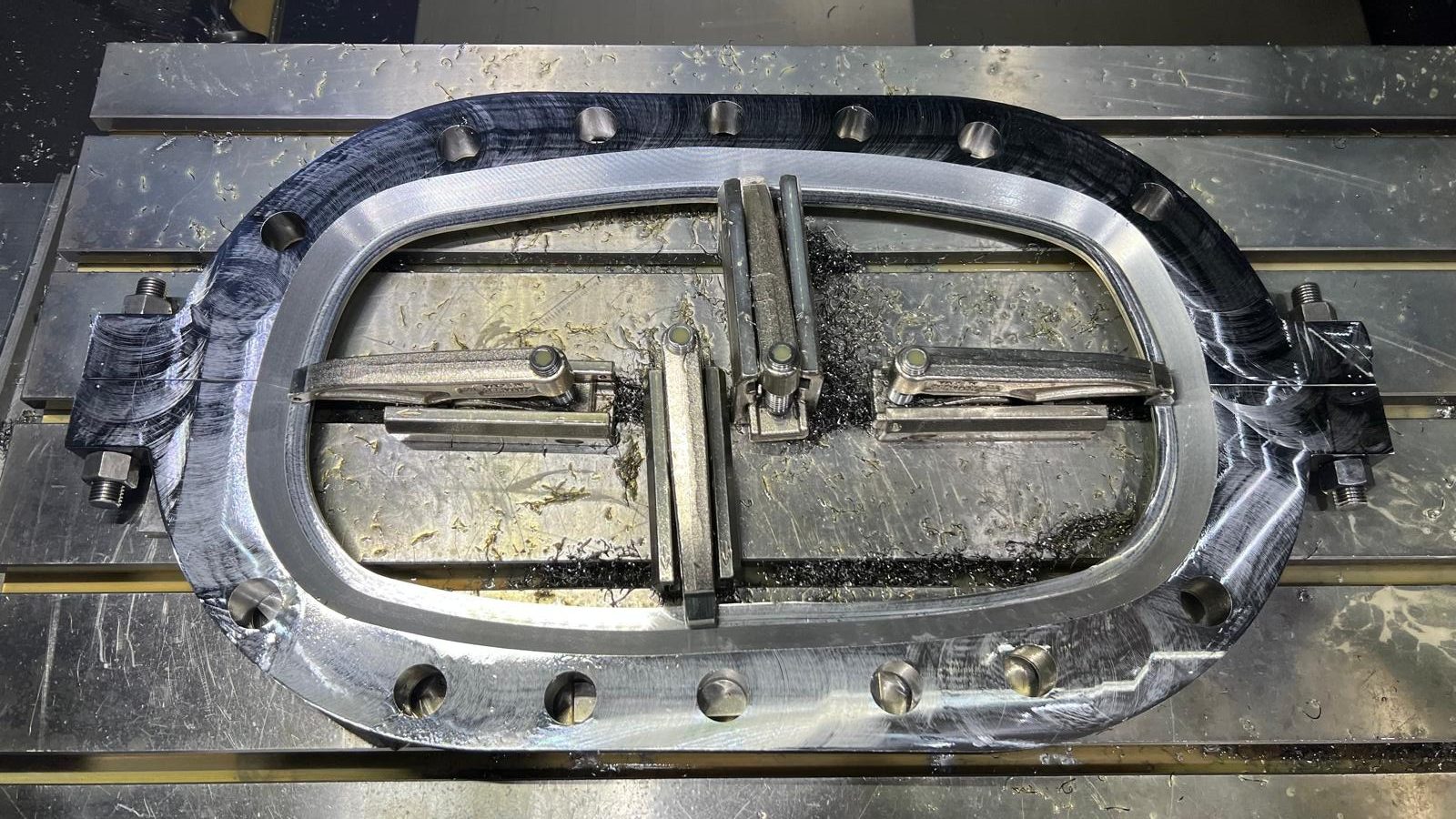 In this context, the decision to adopt ramp machining proved to be crucial. This strategy made it possible to effectively handle the geometric complexity of the component, distributing cutting forces and ensuring greater stability during material removal.
However, this choice also introduced a new challenge: managing an extremely large G-code, with a direct impact on the memory limits of the machine tool.
 And it is precisely at this point that the project took a significant leap forward.
Limits were not considered a constraint, but a starting point. Through analytical and operational work, practical solutions were identified for managing and controlling the code, adopting alternative approaches that made it possible to achieve maximum results without the need for additional investments.
The result is a production system now capable of handling complex machining operations and particularly heavy programs while maintaining stability, precision, and quality throughout the entire process.
However, the most significant value of this achievement does not lie solely in technology.
It lies in people.
Continuous collaboration with machine operators has been a key element in every phase of the project. It is thanks to this constant dialogue that a program evolves from simple execution into an optimized and high-performing process. It was not just about programming and producing, but about building a method together, correcting in real time, improving step by step.
The integration of operational experience and digital development has generated a concrete, tangible result.
In just three months, this synergistic effort made it possible to bring the Doosan DNM 6700 to its maximum operational potential.
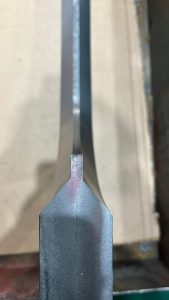
One detail, more than any other, summarizes the value of this journey: the perfect match between the template (made in light blue) and the machined component. A result that represents not only geometric precision, but the concrete proof of an effective method, genuine collaboration, and total process control.
Because, ultimately, limits exist to be understood.
And, above all, to be overcome. Together.